In Mallorca, the decision between PVC and aluminium isn't based on cold insulation, as national manufacturers repeatedly claim, but rather on solar control and resistance to the marine environment. The island is in climate zone B3—mild winters, hot summers—and the Spanish Building Code (CTE) requires a maximum U-value of 2.5 W/m²K for windows and a solar factor for glazing equal to or less than 0.57 for south and west-facing windows. Replacing the windows in an apartment costs between €2,500 and €6,500 and reduces energy consumption by between 20% and 40%.
Why is the argument about cold weather not valid when choosing windows in Mallorca?
Because most comparisons of PVC and aluminium are written with the interior of the Iberian Peninsula in mind, where the problem is winter. In the Balearic Islands, winters are mild and summers are hot, so the facade opening primarily functions to prevent heat from entering, not to prevent it from escaping.
That completely changes the order of priorities. The figure to look at first in Mallorca isn't the frame's transmittance, it's the solar factor of the glass and the solar protection of the opening. A window with a magnificent frame and non-solar-control glass on a west-facing facade in Palma turns the living room into a greenhouse from June to September, and the air conditioning spends the summer compensating for it.
The Technical Building Code includes it in its basic document on energy saving, the DB-HE, published on the CTE websitefor zone B3, the maximum U-value of the window opening is 2.5 W/m²K, and the solar factor of the glazing is equal to or less than 0.57 for south and west facing windows. Meeting the first requirement is easy with almost any modern window; the second is the one that is often forgotten.
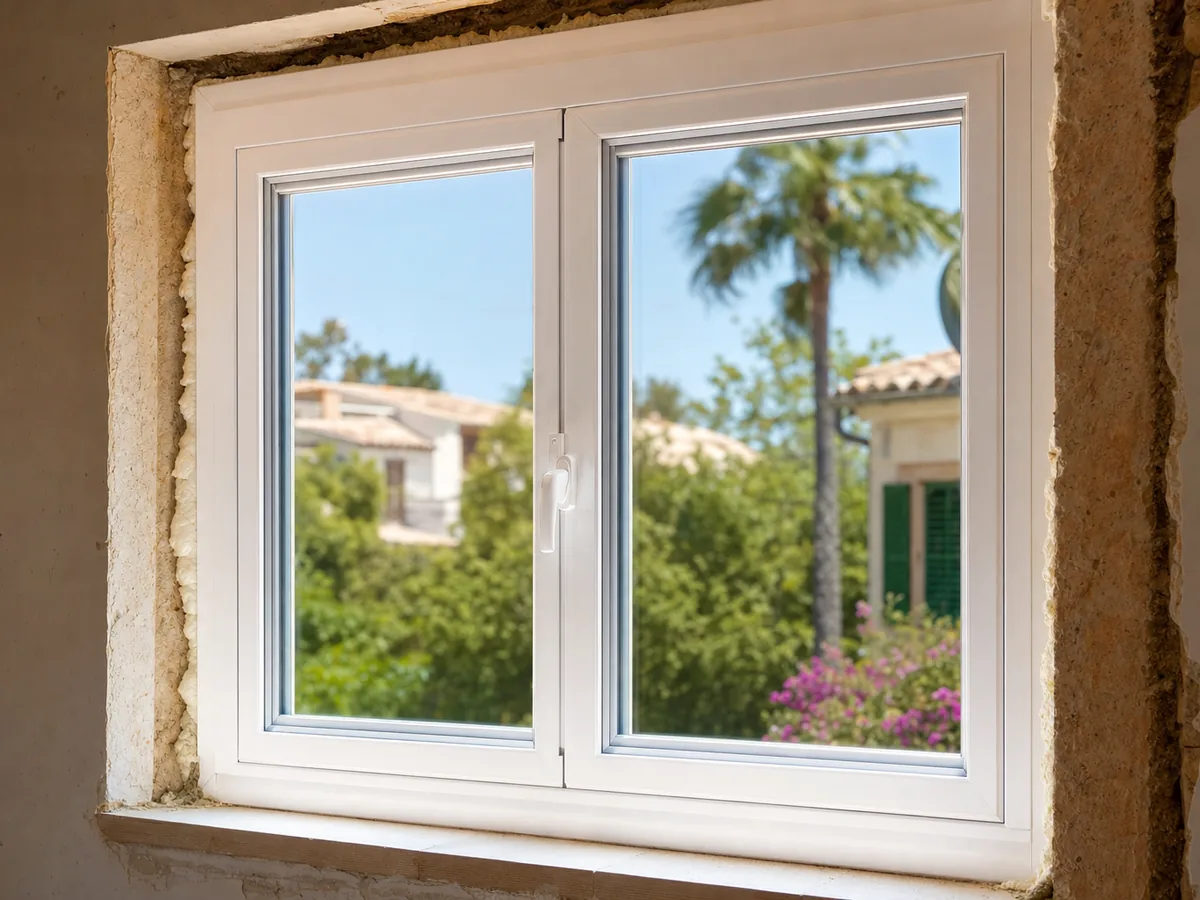
What are the real differences between PVC and aluminium with thermal break?
| Criterion | PVC | Aluminium with thermal break |
|---|---|---|
| Thermal insulation of the frame | Naturally superior | Well, it depends on the quality of the break |
| Sound insulation | Very good with suitable glass. | Good with suitable glass |
| Behavior in a marine environment | Very stable, does not corrode | Good with proper lacquer and hardware; bad if they are standard |
| Large dimensions and sliding doors | Limited by the profile thickness | Better: allows for large sheets and thin profiles |
| Starting price | From around €180 per window | From around €220 per window |
| Aesthetics in the old town | Less versatile in wood imitation | Best for slender profiles and traditional joinery |
| Maintenance | Minimum | Inspection of joints and fittings on the coast |
The honest assessment: for a standard home with normal-sized windows and where insulation and price are priorities, PVC is the most efficient option. For large windows, sliding doors several metres long, or aesthetic requirements on protected facades, aluminium with thermal break is the solution.
Aluminium without thermal break, which is still used in thousands of homes built in the 1970s and 80s in Mallorca, is not comparable: it's a continuous thermal bridge and causes condensation on the frame in winter. If your window has a thin, simple metal profile and drops appear on the frame in January, that's the type.
How much does it cost to replace the windows in an apartment in Mallorca?
Replacing the windows in a three-bedroom apartment, with six to eight openings, costs between €2,500 and €6,500 for PVC or aluminium with thermal break. For wooden windows, the price ranges from €5,000 to €10,000. Each window installed costs between €300 and €800 depending on the size, opening type, and glazing.
| Concept | Estimated price 2026 |
|---|---|
| PVC window, from | 180 € |
| Aluminium window with thermal break, from | 220 € |
| Wooden window, from | 300 € |
| Complete house with 8-10 rooms | €3,000 – €7,000 |
| Annual savings on energy bill | €200 – €700 |
Regarding savings: replacing old windows with thermally broken, double-glazed windows reduces energy consumption by between 20% and 40%, and the investment pays for itself within 5 to 14 years. In Mallorca, the payback period tends towards the longer end of that range because heating costs are lower than on the mainland; however, the improved comfort in summer and the reduction in noise are noticeable much sooner.
And do not forget the grants: there are energy retrofit programmes and income tax deductions for efficiency improvements. We have them collected for the Balearic Islands in grants and subsidies for home renovations in the Balearic Islands, and the initial technical requirements are in the Royal Decree 314/2006 approving the Technical Building Code.
Which woodworking style holds up best near the sea?
PVC, because it doesn't corrode. Right on the seafront, just a few metres from the water, PVC doesn't have the problem of corrosion, and its long-term performance is very stable. Aluminium works well if—and only if—it has a marine-grade coating and marine-grade stainless steel fittings and screws.
This is the most expensive mistake in coastal renovations: choosing the right aluminium frame and skimping on the hardware. The sash might be perfect, but the hardware could seize up after three years, and replacing the hardware on a large sliding window costs a significant fraction of the window's price. If the property is in Port d'Andratx, Cala Pi, El Molinar, or any other exposed location, the hardware specifications are just as important as the frame profile.
A maintenance tip that almost no one gives: in coastal areas, joints and fittings should be checked and lubricated every two or three years, and the profiles cleaned with fresh water. It's half an hour of work that extends the life of the woodwork by years.
Are there any aesthetic limitations to respect in Palma's old town?
Yes. In listed buildings or within heritage-protected areas, the type of joinery, its configuration, colour, and sometimes the material are restricted, and you must check before ordering anything. Replacing a window on a protected facade with one of a different configuration could result in the window being replaced.
In Palma's historic centre, this affects quite a few streets, and the criteria are not uniform: it depends on the level of protection afforded to the specific building. What is consistent, however, is the requirement to maintain the original design, the slender profile, and the traditional shutters, where present. In these cases, aluminium with thermal break and a wood-effect finish is usually the solution that best combines aesthetic regulations with thermal performance.
Before ordering joinery in a building in the old town you have to check its level of protection and, where applicable, apply for the corresponding authorisation. It is a separate procedure from the prior notification of minor works, and we explain it along with the rest in permits and licences for renovating in Mallorca.
When it's NOT worth changing the windows
Three scenarios where money goes further in another area:
- The carpentry is recent and already has thermal break and double glazing. If the problem is summer heat, it is much cheaper to add exterior sun protection —awning, blind, solar control film— than to replace the window.
- There is an unresolved facade leak. Replacing the window doesn't fix a water leak at the joint; the facade needs to be addressed first.
- The real problem is the noise, and only the glass is being replaced. For noise reduction, the asymmetric laminated glass and the sash's airtightness matter more than the frame material. We address this in How to insulate your home from outside and inside noise.
Frequently asked questions about changing windows during a renovation
Which windows insulate better, PVC or aluminium?
PVC provides better natural insulation because the material itself is a poor conductor of heat, while aluminium requires a thermal break to achieve comparable performance. That said, high-quality aluminium with a thermal break and good glazing more than adequately meets the requirements of the CTE (Spanish Technical Building Code) in the Balearic Islands. In Mallorca, where summer is the main problem, the glazing and its solar factor have a greater impact on the final result than the frame material.
How much can you save by replacing the windows in a home?
Between €200 and €700 annually on energy bills, depending on the climate zone and the condition of the existing windows and doors, with a reduction in consumption of between 20% and 40% of the total energy bill. In Mallorca, the savings are concentrated more in cooling than heating, so they are especially noticeable during the summer months. The investment is recouped within 5 to 14 years.
Can the windows be changed without the community's permission?
If the opening, colour, and exterior appearance remain the same, it is usually sufficient to notify the authorities of the work, as the building's exterior configuration is not altered. However, if the colour or the paneling is changed, the opening is modified, or the original shutter is removed, authorization from the homeowners' association is required, since the facade is a common element according to the regulations Horizontal Property Law. We detail it in which works require approval from the owners' meeting.
What thermal transmittance should windows have in the Balearic Islands?
In climate zone B3, which includes the Balearic Islands, the Spanish Building Code (CTE) requires a thermal transmittance of the window opening equal to or less than 2.5 W/m²K and a solar factor of the glazing equal to or less than 0.57 for south and west-facing windows. Almost any modern window meets the first requirement; the second is often overlooked and has the greatest impact on summer comfort in Mallorca.
We tell you what kind of window your house needs
The right window depends on the orientation of each opening, the distance to the sea, and whether the building has any protected status. The decision for a north-facing facade in Marratxí is not the same as for a west-facing window on the seafront. We'll take a look, measure, and recommend materials and glass for each opening. We are a renovation team in Mallorca with three generations in the trade, a fixed labour price, and a one-year guarantee on the renovation and two years on materials. If the carpentry is part of a larger project, check it out in our Comprehensive renovation service in Mallorca.