Living in your home during a complete renovation is only possible if the property has more than one bathroom, the work can be carried out in sections, and there's a temporary kitchen. In a one-bathroom apartment or one smaller than 80 square metres, staying in extends the renovation by 20 to 40 days and increases the likelihood of conflicts. Moving out for eight or ten weeks costs less than the cost of the delays, the dust everywhere, and the hasty decisions.
Can you live at home during a full renovation?
It depends on three conditions that are either met or not, with no middle ground: that there is a second usable bathroom, that the building can be divided into watertight sections, and that there is a place to cook and wash. If one of the three is missing, the honest answer is no.
And there's a fourth, non-technical condition: the actual tolerance of those living inside. A complete renovation generates constant noise for weeks, silica dust that reaches everywhere, water and electricity outages, and people coming and going from the house from eight in the morning. Some families cope well, while others reach their breaking point by the third week. This is information that no one can give you but yourself, but it's worth considering beforehand, not in the third week.
We ask this on the first visit and give our opinion even if it is not requested, because a client living inside a construction site that does not allow for coexistence ends up with a poorly executed project: they rush to finish, they leave finishing touches and the decisions are made under pressure.
How long does a renovation take if you live inside?
Living inside extends the work by between 20 and 40 weeks. A complete renovation of 10 weeks becomes 12-14 weeks, and one of 16 weeks can go from 20 to 22 weeks.
The reason isn't that the work is done more slowly, it's that it's done differently. Daily cleaning is required to make the house habitable, protective barriers have to be divided into sections and reinstalled each time a new area is moved, materials can't be left piled up in the middle of the work area, the water supply has to be shut off only in agreed-upon sections, and the demolition work is concentrated in narrower time slots. Each of these things takes time.
It also increases costs. More cleaning days, more protective equipment, more material handling, and sometimes double work because one job has to be done in two shifts. When someone asks us for a quote for both scenarios, the difference is usually between 8% and 15% more expensive for those living on-site. Add that to the extended lease term and compare it to temporary rent: the numbers almost always prove the advantage of moving in.
What renovations do allow you to continue living at home?
| Type of renovation | Is it possible to live inside? | Condition |
|---|---|---|
| Painting and flooring replacement in phases | Yeah | Empty one area at a time |
| Bathroom renovation (with another one available) | Yeah | Second working bathroom |
| Kitchen renovation | With difficulty | Temporary kitchen and microwave |
| Renovation of a single bathroom | No | Without a bathroom, there is no home. |
| Complete renovation with new installations | No | General water and electricity outages |
| Intervention in structure or slabs | No | Security |
The two cases where safety reasons led to a "no" are non-negotiable. When work needs to be done on floors, shoring up, or structural intervention, no one lives inside. And with new utilities, there are entire days without water or electricity, with trenches dug throughout the house.
Kitchen renovations are an interesting middle ground: you can manage for three to five weeks with a temporary setup—a portable induction hob, microwave, refrigerator in another room, and a replacement sink in the bathroom or laundry room—and many people do it without any fuss. You just have to accept five weeks of eating differently.
How is a building organised so that it can be lived in?
If you decide to stay, the project will be planned differently from the beginning. These are the seven points we agreed upon in writing before starting:
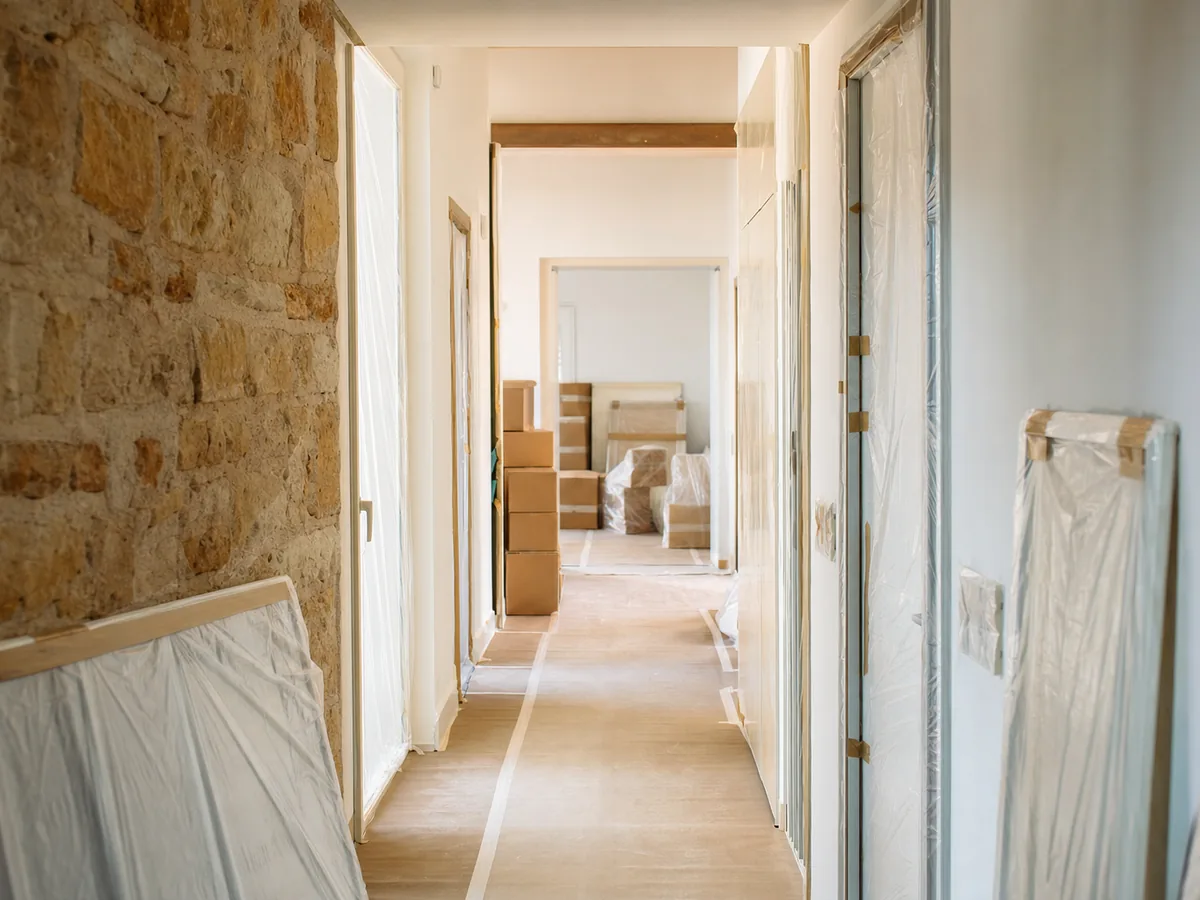
- Section off with temporary partitions or film and tape, not with a sheet.
- Define an untouchable clean zone: a bedroom and a bathroom that are not to be stepped on with construction boots.
- Concentrate the chipping and demolition in the first few days, consecutively and not spread out.
- Set working hours and communicate in advance the days of water and electricity cutoff.
- Install a temporary kitchen before dismantling the existing one, not after.
- Daily cleaning of the inhabited area at the end of the day.
- Dust extraction in cutting tool and forced ventilation of the work area.
Point 7 is not a luxury. Ceramic and concrete cutting dust contains respirable crystalline silica, a recognized occupational hazard about which the The National Institute for Occupational Safety and Health has specific informational material for construction materials, And breathing it in daily for weeks in your own home is not the same as breathing it in with respiratory protection, as on a construction site. If there are young children, elderly people, or someone with respiratory problems in the home, this point alone is often the deciding factor in moving.
Is it cheaper to move or stay during the renovation?
Moving is almost always cheaper, even though it might seem that way at first glance. You have to compare the cost of temporary accommodation against the additional construction costs plus the extended deadline, and in Mallorca there's a factor that throws off the calculation: the seasonality of the rental market.
A short-term rental of two or three months between October and April is reasonably priced on the island. In July and August, it's not. Therefore, when the property isn't suitable for overnight stays, our conversation with the client focuses on scheduling: planning the renovations during the off-season allows for a significantly lower price, and the work progresses more efficiently. If you're considering the timing, we can discuss it in... When is the best time to do a renovation?.
And there's a type of saving that doesn't appear on any spreadsheet: decisions made calmly. Choosing a material because you're convinced by it, not because you've been sleeping surrounded by plastic for five weeks and you just want it to be over.
When you should NOT stay home during construction
Four scenarios in which we always recommend moving, even if the client insists on staying:
- The house has only one bathroom. And that bathroom is being renovated. There's no reasonable temporary solution.
- There are babies, elderly people, or someone with breathing problems. living with construction dust.
- Work is being done on the structure or slabs, for safety and without exceptions.
- The plumbing and electrical systems are completely renovated., because it implies days without basic services.
If the property is old, the probability of ending up in the last two scenarios is high, even if it wasn't initially planned. renovating an old apartment in Palma We explain what usually appears when you open it, and in How to plan a renovation without stress how to organise the rest of the process.
Frequently asked questions about living at home during a renovation
Is it possible to live in an apartment while the kitchen is being renovated?
Yes, it's one of the most viable options, provided a temporary kitchen is set up before dismantling the existing one: a portable stovetop, microwave, relocated refrigerator, and an alternative water source in the bathroom or utility room. You have to be prepared for three to five weeks without a proper kitchen and quite a bit of dust in the adjoining rooms. With only one bathroom and the kitchen open to the living room, living together becomes much more uncomfortable.
How much dust does a complete renovation generate, and how much can it be avoided?
Dust cannot be avoided, only contained. With airtight compartmentalization, a dust extraction system connected to the cutting tool, forced ventilation of the work area, and daily cleaning, dust is greatly reduced, but a complete renovation involving chipping always leaves the entire house dusty. This is the main reason why we don't recommend living with construction work underway when there are small children or people with respiratory problems in the home.
How much more expensive is a renovation if I live inside the house?
Between 8 and 15 additional %, due to extra cleaning days, protective measures, material handling, and tasks that need to be completed in two shifts instead of one. Added to this is the 20-40 % extension, which is the truly significant cost. When compared to the price of a two- or three-month short-term rental in the off-season, moving is usually cheaper.
Is it possible to live in the house if all the pipes and electrical wiring are replaced?
It's not recommended. Completely renovating the plumbing and electrical systems requires opening chases throughout the entire house and means days without water and electricity, as well as constantly moving furniture. This is the scenario where the work takes the longest if it has to be done while the house is occupied. We explain this in detail in When should the pipes be changed during a renovation?.
We'll discuss it with you before we begin
During the initial visit, we'll tell you frankly whether your home can accommodate the construction work or not, and we'll provide you with two options, including timelines and prices, so you can make an informed decision. We've been doing this for three generations Home renovations in Mallorca, with a fixed labour price and a one-year warranty on the renovation and two years on materials. If you want to see the full scope, it's on our website. Comprehensive renovation services in Mallorca.