Yes, it is possible to cover a light well, but three conditions must be met: approval from the homeowners' association (usually with a 3/5 majority vote if it is a common element), a building permit from the city council, and a technical project guaranteeing that the ventilation and natural light provided by the light well to the building will not be compromised. Doing so without permits risks a lawsuit and the possibility of having to demolish the structure, resulting in the loss of the invested money.
Covering an interior courtyard to create a room, a gallery, or a sheltered area is one of the most sought-after renovations in Palma apartments. And it's also one of the most problematic when done incorrectly. Because an interior courtyard isn't just "your" space: it serves a purpose for the entire building. Let's see how to do it right.
Is it legal to cover a light well?
Yes, it is legal to cover a light well, provided you have the authorization of the homeowners' association if it is a common element and the necessary building permit from the city council. The key is that the work does not impede the ventilation or natural light that the light well provides to the other apartments.
The important distinction is ownership. Just because a neighbor has exclusive use of the light well—because they live on the ground floor, for example—doesn't automatically give them the right to enclose it. Exclusive use allows for the use of the space, but its function must be respected. Therefore, before any work is done, it's essential to clarify who owns the light well and what the building's deed states.
What permits are needed to cover a light well?
To cover a light well, two permits are generally required: approval from the homeowners' association and a municipal building permit. If the light well is a common element, modifying it is considered an alteration that requires a three-fifths majority vote of the owners.
These are the usual permits and documents:
- Agreement of the owners' association, with the item previously included in the agenda.
- Building permit from the relevant town hall, in accordance with local urban planning regulations.
- Signed technical project justifying the solution and its impact on light and ventilation.
Ignoring the community agreement is the most costly mistake: even if you have the municipal permit, another neighbor can challenge the work. We also explain this in similar cases such as enclosing a penthouse terrace.
How to cover a light well step by step?
- Check the building's deed of incorporation to find out if the patio is common or private.
- Commission a technician to undertake a project that studies the solution and its impact on ventilation and lighting.
- Take the proposal to the owners' association and obtain the necessary agreement.
- Apply for the building permit at the town hall with the technical project.
- Carry out the work with a company that respects the approved project.
- Keep all documentation: agreement, license and final certificate.
Order matters. Starting construction before having the necessary agreements and permits is what ultimately leads to demolition. That's why it's advisable to hire a company that also coordinates the technical and permitting aspects, as we do in our projects of apartment renovations in Mallorca.
What does the regulation say about light wells?
Regulations concerning light wells are based on the Horizontal Property Law and the Technical Building Code. The Horizontal Property Law allows for modifications to a light well provided that the building and other owners are not harmed, and the Technical Building Code establishes the minimum requirements for ventilation and natural lighting that must be met.
The Article 7 of the Horizontal Property Law regulates alterations to common elements, and the Technical Building Code establishes the health and habitability conditions. In Mallorca, municipal and regional urban planning regulations also apply, so it is advisable to confirm the ordinances of the Palma City Council or of the specific municipality before planning the project.
What can be used to cover a light well?
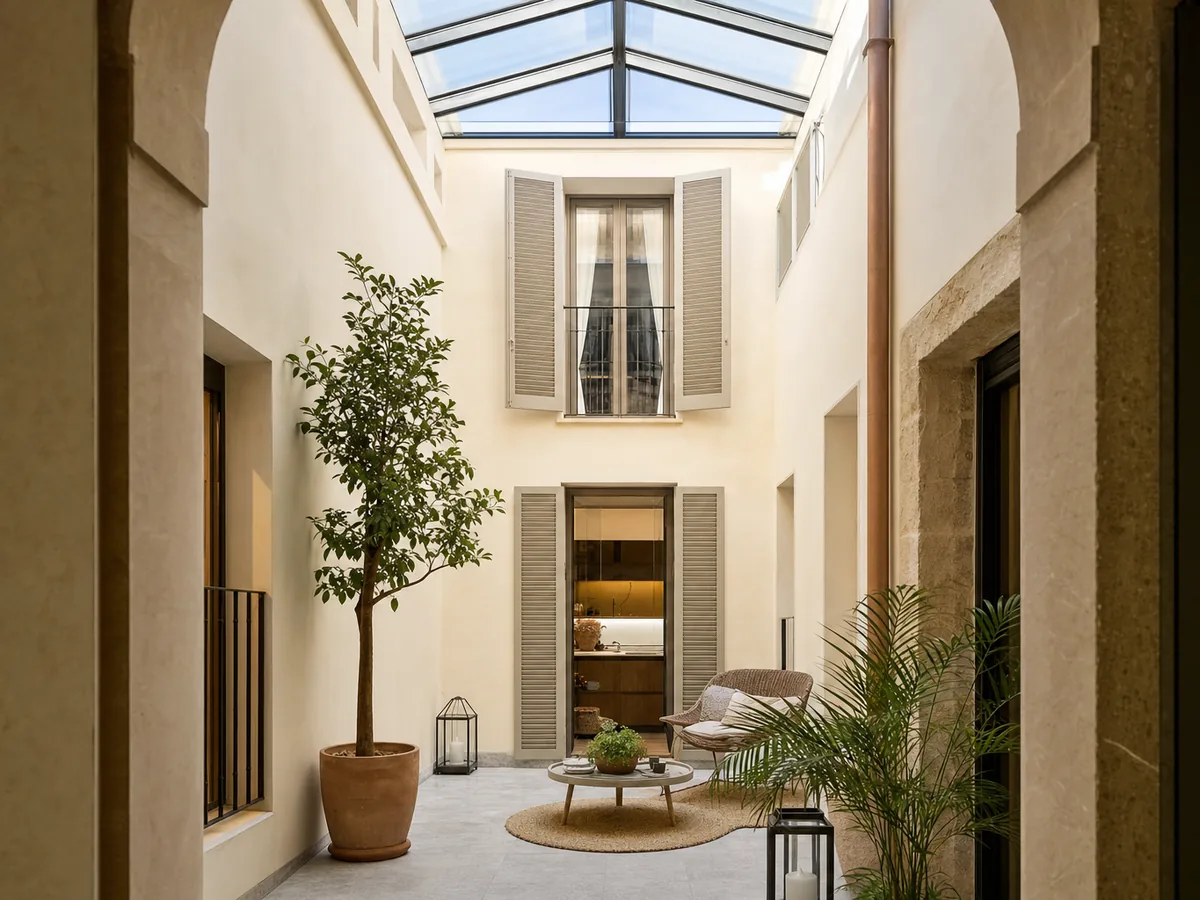
A light well can be covered with solutions that allow light in while maintaining ventilation, such as skylights, glass roofs, polycarbonate, or retractable roofs. The choice depends on whether an enclosed space is desired or simply protection from the rain.
The most common options:
- Fixed skylight or rooflight: lets light in, closes the space to the rain.
- Retractable or retractable roof: allows it to be opened for ventilation, very useful to avoid losing the function of the patio.
- Glass or polycarbonate: They maintain the luminosity that an opaque enclosure would lose.
The technical solution is not merely aesthetic: it must ensure that the other dwellings continue to receive the light and air that the courtyard provided. Hence the importance of the project.
What happens if I cover a light well without permission?
If you cover a light well without permission, you risk being forced by the community or the city council to demolish the structure and restore the light well to its original state, in addition to possible fines. You lose the money you spent on both the construction and the demolition.
Construction carried out without community approval can be challenged by any property owner, even years later. And construction without a building permit can lead to a planning investigation. It's not worth taking the shortcut: legal construction involves more paperwork, but it's the only one that stands.
When can't a light well be covered?
You cannot cover a light well if doing so would deprive other apartments in the building of ventilation or natural light, because the Building Code (CTE) and the Horizontal Property Law protect that function. Nor can you cover it if the building's residents' association does not approve the work in a shared courtyard, even if you have exclusive use of the space.
And it's best to rule it out if the city council won't grant a permit due to local zoning regulations. In those cases, there are less intrusive alternatives—retractable awnings, lightweight, removable solutions—that can address the rain without disrupting the patio. We can help you assess what's feasible for your specific building.
Frequently asked questions about covering a light well
Do I need permission from the community to cover a light well in my apartment?
Yes, if the light well is a common element, you need the agreement of the homeowners' association, usually with a 3/5 majority vote, because covering it is considered an alteration of a common element. Even if you have private use of the light well, that use alone does not authorize you to enclose it without the approval of the other residents.
Is a building permit required to cover a light well in Mallorca?
Yes, covering a light well requires a building permit from the relevant town hall, as it affects the building's configuration and its ventilation and lighting conditions. A technical project must be submitted, and local urban planning regulations and the Building Technical Code must be followed. Without a permit, the work is illegal and may be ordered to be demolished.
Can I cover a light well if I live on the ground floor and only I use it?
Living on the ground floor and using the light well does not automatically grant the right to cover it. If the light well is a common element, community approval is still required, because covering it could affect the ventilation and lighting of the rest of the building. Private use allows you to utilize the space, but its original function must be respected.
What happens to ventilation if I cover the light well?
If you cover the light well, you must ensure that the building maintains the ventilation and natural light required by the Building Technical Code. Therefore, practical solutions that allow air to pass through are used, and a technical project studying the impact is mandatory. An enclosure that stifles ventilation in other dwellings is not legal.
Do you want to cover the light well of your apartment in Mallorca? We can help you.
Covering a light well properly starts with a good design and all the necessary permits. We are a Home renovation company in Palma de Mallorca , with a fixed labor price, guarantee and 100% financing, and we accompany you from the technical project to the construction. Book your appointment here or write to us from contact, and learn about our service apartment renovations in Mallorca.
This content is for guidance only and does not replace legal advice or a technical project for your specific building.