Renovating a stone house in Mallorca requires techniques compatible with the local sandstone and lime mortar: addressing rising damp, preserving load-bearing walls, and insulating without sealing the stone. In 2026, a complete renovation cost between €1,800 and €2,800/m² (approximately €60,000 for 100 m²) and, in historic districts, usually requires a municipal permit and, sometimes, a heritage report from the Consell de Mallorca (Island Council of Mallorca).
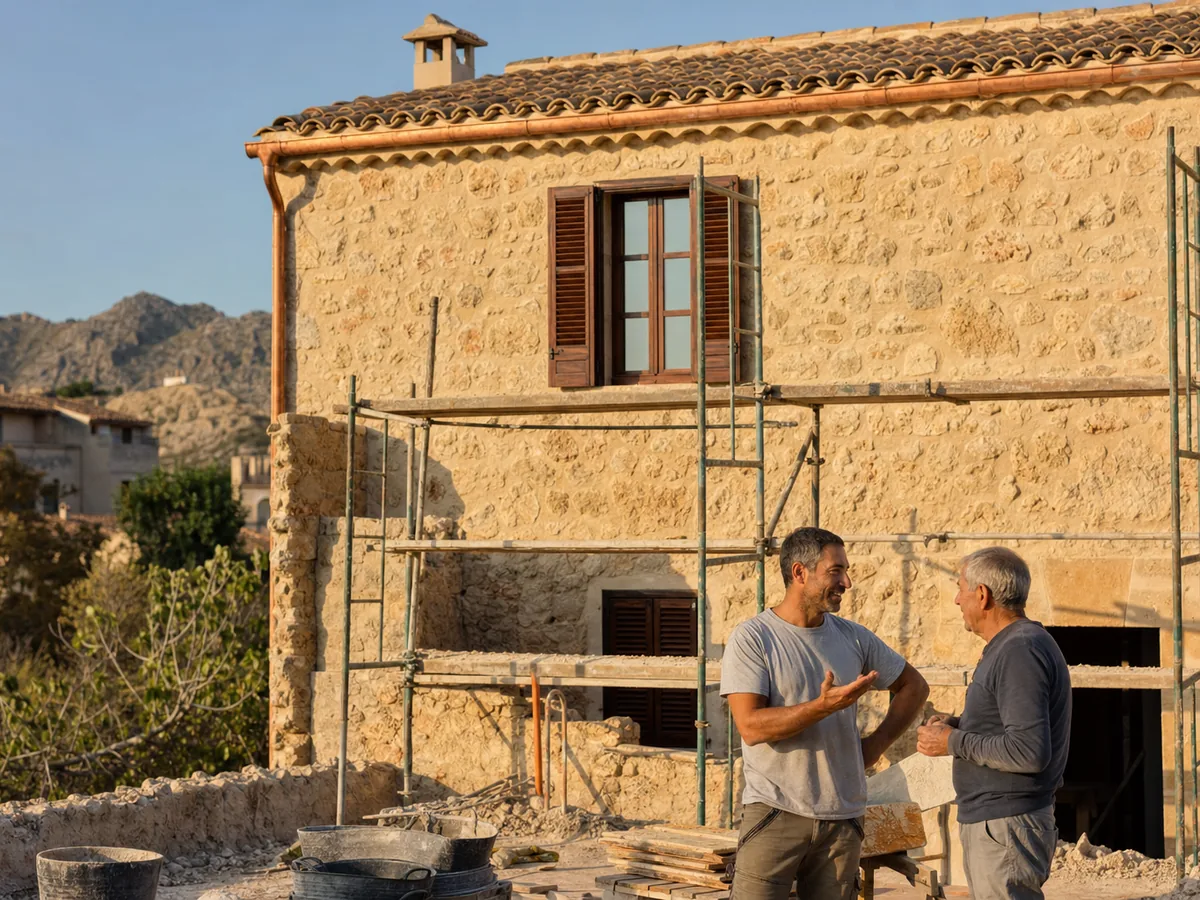
Renovating a stone house in Mallorca is nothing like renovating an 80s apartment. The challenge here isn't just aesthetic: it's about understanding how a 60-centimeter-thick marès stone wall "breathes," why dampness rises from the ground, and which original elements—marès stone arches, moldings, wooden beams—deserve to be preserved. Village houses, traditional Mallorcan farmhouses, and marès stone homes have functioned according to their own logic for centuries, and forcing them with cement or plastic paint is usually costly. In this guide, we explain, with the expertise of a family business with more than three generations on the job site, how to tackle each technical problem without destroying the character of the house. If you've inherited the property, you might also be interested in our guide on How to renovate an inherited house in Mallorca. We develop that specific point, including treatments and prices, in How to eliminate dampness during a renovation in Mallorca. This is the type of housing that dominates the town centers of many villages on the island: you can see how we work the renovations in Llucmajor and its coast.
What makes renovating a stone house in Mallorca different?
What sets these houses apart is the material: marès stone and limestone set with lime mortar, without modern insulation, and with walls that naturally absorb and release moisture. Any renovation that ignores this "breathing" process ends up with dampness, saltpeter, and cracks. These are the challenges that almost always arise:
- Capillary action: water from the ground that rises through the pores of the stone.
- Load-bearing walls of great thickness that condition the distribution.
- Wooden beams and joists attacked by xylophages or rot.
- Arabic tile roofs with leaks and non-existent insulation.
- Obsolete facilities to renovate without destroying the wall.
- Low thermal efficiency, without an air chamber or insulation.
- Heritage regulations in old towns and listed buildings.
At Tecnic Project we always start with a prior diagnosis and propose the Complete house renovation in Mallorca with a fixed labor price, so there are no surprises mid-project. This table summarizes the most common problems and their compatible solutions:
| Typical problem of the stone house | Compatible technical solution |
|---|---|
| Rising damp at the base of the wall | Chemical barrier by injection of hydrophobic resins + breathable lime plaster |
| Walls coated with cement that "smother" the stone | Remove the cement and re-point with breathable lime mortar |
| Heat loss through walls and roof | Exterior insulation or ventilated cavity with natural insulation (cork, wood fiber) |
| Wooden beams damaged by woodworm or moisture | Consolidate, reinforce, or replace on a case-by-case basis; never wholesale without a diagnosis |
| Load-bearing wall that obstructs the new layout | Opening with a lintel or tie beam calculated by a technician; never demolish without a structural calculation |
| New installations in 50-70 cm walls | Minimal chases, visible registers or channeling through false ceilings and new partitions |
| Arabic tile roof with leaks | Remake the skirt with a breathable waterproof membrane and replace the original tile |
How to eliminate rising damp in stone and marès walls
This is the number one problem with these houses: groundwater rises through the capillaries in the stone, carrying salts that cause the plaster to peel. It won't "dry" with damp-proof paint. The real solution combines stopping the rising water and restoring breathability to the wall. The typical technical plan is:
- Diagnosis with hygrometer and thermal imaging camera to measure the actual humidity level and its origin.
- Moisture barrier, usually by injecting hydrophobic resins into the base of the wall, creating a strip that prevents capillary rise.
- Removal of cement and the plastic plasters that waterproofed the exposed face.
- New lime coating (mortars and mineral paints), breathable and hygroscopic, allowing residual moisture to evaporate.
- Perimeter drainage when the ground pushes water against the house.
Lime is key: it's breathable, compatible with marès stone, and prevents the hard spots that crack an old wall. The Technical Building Code regulates these health and moisture protection requirements in its basic document DB-HS; you can consult the current regulations on the official website of the Technical Building Code.
How to thermally insulate a stone house without losing its character
It's possible, but almost never "from the inside" by gluing polystyrene to the wall, because that kills thermal inertia and causes condensation. The correct strategy is to insulate while respecting the original bioclimatic design: from the outside when the facade allows it, or with breathable solutions from the inside when the exposed stone must be preserved. Options that work in Mallorca:
- External insulation (compatible SATE or lime insulating mortar) on facades without heritage value.
- Breathable wall linings with cork, wood fiber or mineral wool when insulation is needed from the inside.
- Ventilated roof with insulation under the tile, where the most heat is lost.
- New carpentry shops with thermal break and low-emissivity glass.
Energy efficiency is now a key element of renovation according to the DB-HE section of the CTE (Spanish Technical Building Code), and it greatly improves the comfort of a village house. If you're also concerned about noise—common in towns like Palma, Sóller, or Pollença—check out our guide on How to insulate your home from outside and inside noise.
What to do with load-bearing walls, wooden floors and Arabic tile roofs
The structure is what cannot be improvised. In a stone house, many walls are load-bearing; the ceilings are usually made of wooden beams and vaulted ceilings, and the roofing is typically Arabic tiles over reed matting. Before touching anything, a structural assessment is necessary. Common interventions:
- Load-bearing walls: Any opening requires a metal lintel or tie beam calculated by a technician. Demolition is never done "by eye.".
- Wooden beams: They are inspected one by one; those damaged by woodworm or rot are consolidated or replaced, and those that are healthy can be left exposed.
- Arabic tile roof: The skirt is remade with breathable and insulating sheeting, replacing the original tile to maintain the aesthetics.
When renovating a structure, it's the perfect time to prepare for the new installations. Utilizing existing false ceilings and partitions avoids destroying the original walls, something we explain in detail in [link to relevant article] renew the electrical installation in a renovation.
What permits and licenses do you need to renovate in a historic center?
It depends on the municipality and the level of protection. Any renovation involving construction work requires a municipal permit, but if the house is in a historic center or is listed, the island's heritage authorities also become involved Law 12/1998 on the Historical Heritage of the Balearic Islands it assigns control of construction work in protected buildings to the island councils. In practice:
- Planning permission of the corresponding town hall (Palma, Sóller, Artà, Pollença…), each with its own ordinance.
- Asset report of the Historical Heritage Service of the Consell de Mallorca when the property is listed or within a protected complex.
- Technical project signed by architect or building surveyor depending on the scope.
You can review the regional cultural framework on the portal of Government of the Balearic Islands. The deadlines and requirements vary considerably, so it's advisable to check them before finalizing a quote; we detail them in permits and licences for renovating in Mallorca.
How much does it cost to renovate a stone house in Mallorca in 2026?
More than a comparable apartment, and for good reason. In 2026, a complete renovation in Mallorca ranges from €1,800 to €2,800/m², and a stone house of around 100 m² costs around €60,000; high-end properties with premium finishes exceed €2,800-€5,000/m². The higher cost is due to the age of the property, humidity, structural reinforcement, and the traditional work with lime and marès stone. Factors that influence the budget:
- Starting state: Humidity, structure and roof make the difference.
- Quality of finishes: custom carpentry, natural stone, home automation.
- Surface area and layout: Openings in load-bearing walls increase costs.
- Asset protection: Specific materials and techniques add to the cost.
Prices do not include VAT (10% for primary residences), technical fees, or licenses. At Tecnic Project, we work with fixed labor price, Financing up to 100%, a 101% discount on materials, and a one-year warranty on the renovation and two years on the materials, so you know from the beginning how much you will pay.
Frequently asked questions about renovating a stone house in Mallorca
How much does it cost to renovate a stone house in Mallorca in 2026?
A complete renovation in 2026 will cost between €1,800 and €2,800/m², so a stone house of around 100 m² will cost approximately €60,000, excluding VAT and permits. High-end renovations will cost between €2,800 and €5,000/m². The price depends on the condition of the structure, dampness, heritage protection status, and finishes. A fixed-price quote with a set labor cost will prevent cost overruns.
How do you eliminate rising damp in a stone or marès wall?
It cannot be eliminated with damp-proof paint. Effective treatment stops rising damp with a chemical barrier created by injecting hydrophobic resins at the base of the wall and then restores breathability by removing the cement and applying lime plaster. If the ground is pushing water, a perimeter drainage system is added. A diagnostic assessment with a hygrometer and thermal imaging camera is recommended beforehand to address the actual problem.
Is it possible to thermally insulate a stone house without losing its traditional character?
Yes. The key is to respect the wall's breathability: insulate from the outside when the facade allows it, or use breathable cork or wood fiber linings when the exposed stone must be preserved. A ventilated roof and windows with thermal break provide the greatest improvement. Avoid using polystyrene glued to the inside, as it causes condensation and damages the marès stone.
Do I need a special license to renovate a stone house in a historic district?
All construction work requires a municipal permit, but if the house is listed or located within a protected area, the Historical Heritage Service of the Consell de Mallorca also becomes involved, according to Law 12/1998 on the Historical Heritage of the Balearic Islands. Each municipality has its own regulations, so the requirements vary. It is advisable to check the level of protection before planning any renovations.
Is it possible to open a load-bearing wall in a Mallorcan stone house?
Yes, but never without structural calculations. A load-bearing wall supports the floor slab, and creating an opening requires installing a metal lintel or a tie beam sized by a qualified professional. Doing it "by eye" can cause cracks or subsidence. In stone houses, shoring is also necessary during construction. With proper planning and reinforcement, open spaces can be created without compromising stability.
When NOT to seal stone or demolish a load-bearing wall
There are decisions that are best avoided, no matter how good they may seem in the short term. Don't seal the stone or touch the structure without the right conditions. Specifically:
- Do not grout or plaster with cement. an old wall: it traps moisture and ruins the stone.
- Do not apply plastic paints on seas; They prevent the wall from breathing.
- Do not demolish a load-bearing wall without project and calculated reinforcement.
- Do not replace all the beams suddenly: many can be consolidated.
- Do not close the cover without insulation or breathable membrane.
- Do not start the work in a listed building without the heritage report.
Request a quote to renovate your stone house
Every stone house is different, which is why renovating a stone house in Mallorca begins with a visit and an honest assessment. At Tecnic Project, we are a family business with over three generations of experience renovating traditional homes, offering fixed labor prices, financing up to 100% APR, and a guarantee. Tell us about your project via WhatsApp, phone, or our contact form and discover our services House and villa renovations in Mallorca. No surprises and with respect for the marès.