Updating the electrical installation is essential when renovating an older apartment: porcelain fuses, the absence of a residual current device (RCD), or aluminum wiring are all signs of risk that violate the REBT (Royal Decree 842/2002). Any renovation that modifies circuits requires a new electrical certificate (CIE) signed by a certified electrician. In 2026, updating the electrical installation of an average apartment in Palma costs between €3,000 and €7,000, depending on the size and level of electrification (basic 5,750 W or high 9,200 W).
Updating the electrical system during a renovation is, in most older apartments in Palma, a technical and safety requirement, not a whim. If your home still has the original fuse box, lacks a residual current device (RCD), or the circuit breakers trip when you turn on the oven and the hob simultaneously, the installation does not comply with the Low Voltage Electrotechnical Regulations (REBT) and must be updated. The same applies to plumbing, and the sensible approach is to address both issues during the same project. When to change the pipes during a renovation.
During a complete renovation, this is the perfect time to get an electrical certificate: the walls are already open, the electrician can run new wiring without additional chases, and everything is certified. We explain the warning signs, the different levels of electrical safety, when the certificate is mandatory, and how much it costs to get it done correctly in 2026.
When should the electrical installation be renewed during a renovation?
You must renew your electrical installation whenever your home hasn't been updated for more than 20-25 years, when you expand or move circuits, or when you change your contracted power. In Palma, a large portion of the housing stock built before the 1990s has installations that no longer comply with current regulations and should be completely replaced during construction.
The reform mandates intervention in these cases:
- The house does not have grounding in all the sockets.
- The panel lacks a differential switch (the one that protects against electrocution).
- The usable area is increased, it is joined to another dwelling, or new rooms are created.
- High-power loads are installed: air conditioning, induction hob, heat pump or electric vehicle charging.
If you are considering the complete renovation of your house, the logical thing to do is to include electricity within the project.
What signs indicate that the electrical installation is obsolete?
An outdated electrical system is recognizable even before you open the panel. The clearest signs are porcelain fuses, aluminum wiring (more fragile and more prone to overheating than copper), and the absence of modern protective devices. Any of these signs, in an older apartment in Palma, justifies a complete overhaul.
Pay attention to these symptoms:
- Porcelain fuses or "plugs"« instead of automatic circuit breakers.
- There is no differential switch. in the picture.
- The circuit breakers blow often when connecting multiple appliances.
- Aluminum cables or with dried fabric/cotton insulation.
- Plugs or mechanisms that get hot, They turn black or smell burnt.
- Few light fixtures and sockets, with power strips and thieves all over the house.
These are common problems when renovating an old apartment in Palma, where the installation falls far short of what current domestic life demands.
What level of electrification does your home need: basic or high?
The electrification level defines the maximum power the installation will support and the minimum number of independent circuits REBT of the Ministry of Industry it includes two levels for homes: basic (5,750 W at 230 V) and high (9,200 W at 230 V). The high level is mandatory in usable areas greater than 160 m², or when air conditioning, electric heating, home automation, or more than 30 light points are planned.
| Degree | Maximum permissible power (230 V) | Minimum circuits | When does it apply? |
|---|---|---|---|
| Basic | 5,750 W | 5 (C1 to C5) | Standard housing without major expenses |
| High | 9,200 W | 7 or more | +160 m², A/C, electric heating, home automation or >30 light points |
If your renovation includes air conditioning or you want to prepare the house for it home automation and smart home integration, the sensible thing to do is to dimension directly to a high degree.
What is an electrical certificate (CIE) and when is it mandatory?
The electrical certificate or Electrical Installation Certificate (CIE) is the official document that certifies that the installation complies with the REBT (Low Voltage Electrotechnical Regulations). It can only be issued by an authorized installer registered in the industrial register, is valid for 20 years, and is mandatory whenever a new installation is carried out, an existing one is renovated, the contracted power is increased, or an old installation without documentation is brought into compliance.
In a renovation that modifies circuits, the CIE is your guarantee that the work complies with the regulations set out in the Royal Decree 842/2002 of the REBT and this is the document the energy supplier will ask for to activate or modify your supply. In the Balearic Islands, the process is registered with the General Directorate of Industry of the Government through the UDIT-001 procedure of low voltage installations.
How to renovate the electrical installation step by step
The process for renovating an electrical installation follows a logical order, starting with the project plan and ending with the signed certificate. In an apartment, the electrical work typically takes between two and five days, not including the subsequent masonry work of covering and painting, which is part of the overall renovation.
These are the usual steps:
- Load study according to the REBT (ITC-BT-25) and the degree of electrification.
- Opening of chases on walls and ceilings (or exposed piping/false ceiling if there is no construction work).
- Removal of old wiring and the obsolete painting.
- Laying of corrugated pipe and copper cable new throughout the entire house.
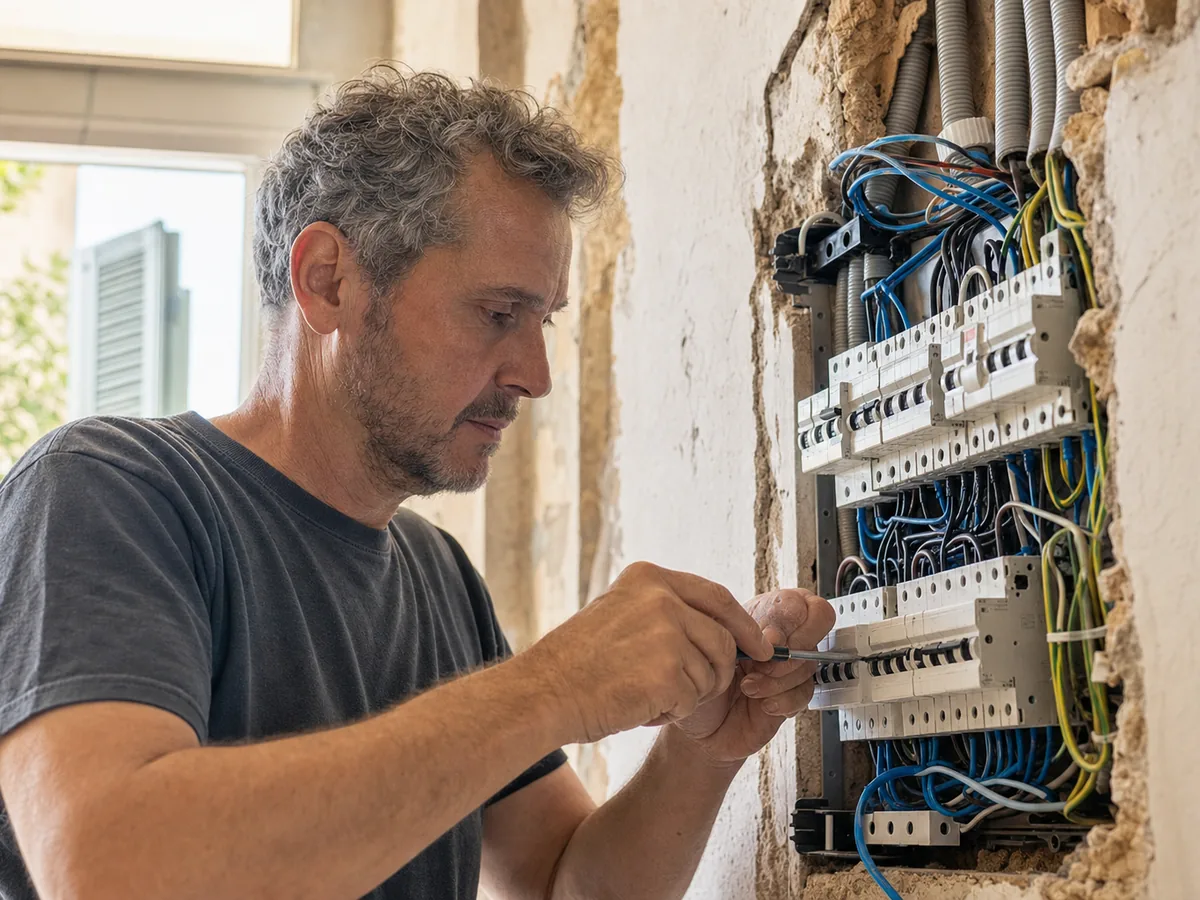
- Main panel assembly with automatic circuit breakers and differential switches.
- Placement of mechanisms: grounded sockets, switches and light points.
- Testing, measurement and issuance of the CIE by the authorized installer.
Fit this calendar into the correct order for renovating a house avoid going over finishes that are already complete: electricity should always be installed before tiling, painting, and flooring.
How much does it cost to change the electrical installation of an apartment in 2026?
In 2026, completely replacing the electrical wiring in an apartment costs, on average, between €60 and €80 per square meter. For a standard 70-90 m² apartment in Palma, the typical cost ranges from €3,000 to €7,000 and includes a new electrical panel, copper wiring, switches and sockets, and the electrical safety certificate. The certificate alone costs around €150-€350.
The final price depends on the surface area and the number of light points, the degree of electrification (high electrification requires more circuits and cable section), the starting condition (removing Bergman tube or aluminum cable increases the cost of the work) and the masonry associated with the chases.
At Tecnic Project, as Family-run renovation company in Mallorca, we work with a fixed labor price and coordinate the authorized electrician within the turnkey renovation, so you know the cost from the beginning and without surprises.
Frequently asked questions about renewing the electrical installation
Is it mandatory to renew the electrical installation when renovating an apartment?
It's not always necessary to completely redo the electrical installation, but it is mandatory to adapt any part of the installation modified during the renovation to the REBT (Low Voltage Electrotechnical Regulations). If you modify circuits, move the electrical panel, or increase the power capacity, the electrician must ensure the work complies with regulations and issue the corresponding certificate. In older apartments in Palma, it's almost always worthwhile to completely renew the installation for safety reasons.
How much does an electrical certificate or CIE for a home cost in 2026?
The electrical certificate for a home costs on average between €150 and €350 in 2026, depending on the power rating and the region. This amount is usually included when you renew the entire installation as part of a renovation, because the same installer who carries out the work is the one who signs and submits the certificate to the relevant industry authority.
Is it possible to change the electrical installation without construction work or chasing?
Yes, there are solutions that don't require chases, such as exposed conduit, suspended ceilings, or raised access flooring, although the finish is less clean. In a complete renovation, there's no point in avoiding chases altogether: since the walls are already open, you can take advantage of the opportunity to conceal all the wiring and leave the home with a flawless finish.
What is the difference between basic and advanced electrification?
Basic electrical installations allow for 5,750 W and five circuits, sufficient for a typical home. Advanced installations allow for 9,200 W and seven or more circuits, and are mandatory in apartments larger than 160 m² or with significant loads such as air conditioning, electric heating, or home automation. If you're unsure, choosing advanced installations will future-proof your home.
When is it NOT necessary to renew the entire electrical installation
It's not always necessary to remove the entire electrical installation. If the house is relatively new, already has a panel with a residual current device (RCD) and circuit breakers, grounding in all sockets, and a valid electrical certificate, then only minor additions are needed: specific circuits or light points are added without redoing the whole thing, provided that the existing power and cable cross-section allow it according to the REBT (Spanish Low Voltage Electrotechnical Regulations).
It also makes no sense to renew simply because of age if an installer inspection confirms that the installation complies with regulations. The prudent approach is to carry out a preliminary assessment: sometimes a well-planned partial renovation solves the problem at a lower cost.
Notice: Electrical installations must always be carried out and certified by a licensed electrician. This guide is for informational purposes only and does not replace the project plans or the certificate signed by a qualified professional in accordance with the REBT (Spanish Low Voltage Electrotechnical Regulations).
Upgrade your electrical installation with the highest guarantees
Are you planning a renovation and want to update your electrical system without any budget surprises? At Tecnic Project, a family business with over three generations in Mallorca, we coordinate the on-site work with a certified electrician, offering a fixed labor price, a guarantee, and 100% financing. Tell us about your project via WhatsApp, phone, or our online form, and we'll prepare a clear quote, including the required electrical certificate, with no hidden costs.