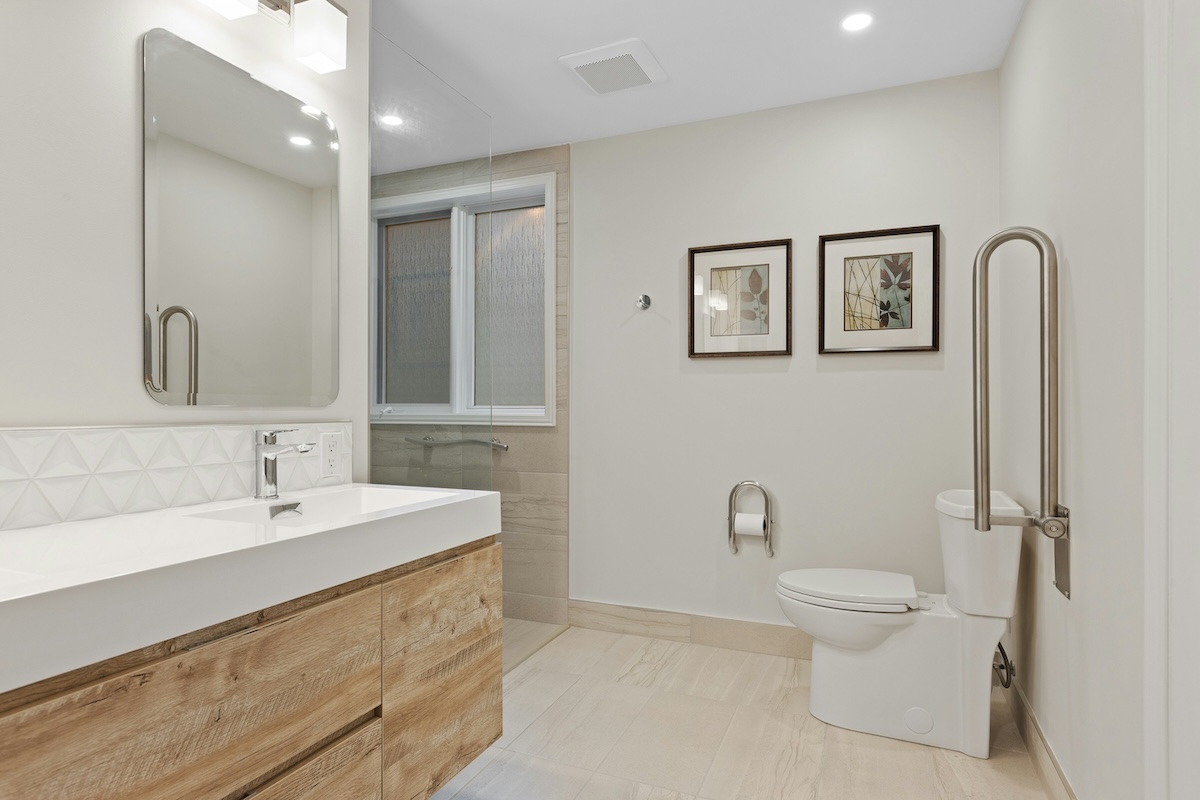
An inclusive bathroom is one that anyone can use independently, regardless of age or physical ability: seniors, children, people with reduced mobility, and the rest of the family. The key lies in four basic decisions—a barrier-free shower, a 1.5m turning space, well-placed grab bars, and non-slip flooring—all of which can be integrated into a renovation without making the bathroom resemble a hospital. In this article, we explain what Spanish regulations say, the exact measurements you must respect, the support available in the Balearic Islands, and the most common mistakes we see every week in homes on Mallorca.
What is the difference between an accessible bathroom and an inclusive bathroom?
An accessible bathroom meets the minimum technical requirements for use by a person with reduced mobility or in a wheelchair. An inclusive bathroom goes a step further: in addition to meeting those requirements, it is designed to be comfortable and aesthetically pleasing for any user of the house, without turning it into a bathroom "for the disabled.".
The practical difference lies in the details: in an inclusive bathroom, grab bars are chosen with a finish that coordinates with the faucets, the continuous shower tray doesn't look like a medical solution but rather a contemporary design choice, and the available space is used for everyday purposes. The result is a bathroom that works today, will work in 20 years, and doesn't detract from the property's value—it enhances it.
What does Spanish legislation say about accessible bathrooms in 2026?
The reference is the Basic Document on Safety in Use and Accessibility of the Technical Building Code (CTE DB-SUA). It sets the minimum requirements that a bathroom must meet to be considered accessible in new construction, public buildings and, in many cases, renovations with public funding or specific permits.
In private homes, there is no legal obligation to adapt an existing bathroom. However, if you apply for regional or national grants for adaptations, the result will be required to meet specific parameters. These parameters also serve as the technical standard that any reputable renovation contractor uses when you request an accessible bathroom: they are designed using real anthropometric data and they work.
Minimum requirements for an accessible bathroom
These are the reference dimensions according to the CTE DB-SUA applicable in 2026:
| Element | Minimum measure | Grades |
| Turning space | Ø 1.50 m | Obstacle-free circle for wheelchairs |
| Entrance door | ≥ 80 cm clear passage | Opens outwards or sliding, never inwards |
| Side space of the toilet | ≥ 80 cm on one side | For transfer from wheelchair |
| Toilet height | 45-50 cm to the seat | Including lid |
| Shower tray | 120 × 80 cm minimum | At ground level, slope ≤ 2 % |
| Horizontal grab bar in shower | 90-100 cm in height | Diameter 30-40 mm, wall separation 45-55 cm |
| Vertical grab bar in shower | 70-75 cm from the ground | Same section and separation |
| Non-slip floor | Class III (Rd) | High slip coefficient |
| Sink height | 80-85 cm | With a 70cm free space underneath for a chair |
Essential elements in an inclusive bathroom
If you're going to renovate the bathroom thinking long-term, these are the elements you shouldn't skip — not even "to save money":
- Walk-in shower tray (extra-flat or walk-in shower) instead of a bathtub
- A folding or sliding screen that does not require force to open
- Thermostatic taps in shower and sink (prevents accidental burns from hot water)
- Grab bars in shower and toilet anchored to the structure, not to a partition wall.
- Wall-mounted folding seat in the shower area
- Generous, shadow-free lighting in the sink and shower (15-300 lux minimum in areas of use)
- Toilet at ergonomic height (45-50 cm) or adapter if it cannot be replaced
- Wall-hung washbasin with free space underneath and long lever single-lever tap
- Class III non-slip flooring (especially important in bathrooms of homes with elderly people)
- Warning or emergency system (alarm cord or push button) in shower and toilet area
How to adapt an existing bathroom without a complete renovation
It's not always necessary to tear down the bathroom. In many homes in Palma, we can adapt it in phases with a very decent, functional result.
- Replacing the bathtub with an ultra-thin shower tray — the most impactful intervention. It eliminates the highest risk of falls in the bathroom.
- Replace the toilet with one of comfortable height (45-50 cm) or install an approved riser if the base is good
- Anchor grab bars in shower and toilet to a structural support verified by the technician
- Replace standard taps with single-lever or thermostatic taps with a long lever
- Replace the flooring with a Class III non-slip floor or apply a non-slip treatment to the existing one if the ceramic material allows it.
- Enhance the lighting with an additional LED light above the sink and a direct spotlight in the shower.
- Install a fold-down shower seat anchored to the wall with structural support
These partial adaptations can be carried out in 5-7 days and represent between 30% and 50% of the cost of a complete bathroom renovation.
Aid and subsidies available in the Balearic Islands (2026)
In the Balearic Islands, there are several avenues of public funding to adapt the bathroom when there is a person with reduced mobility in the home:
- Grants from the Balearic Government and the Ministry of Social Affairs and Sports to improve accessibility in homes and apartment buildings with residents over 65, people with a recognized disability (≥ 33 %), or those in situations of dependency. Regular calls for proposals with funding of hundreds of thousands of euros annually.
- State housing adaptation program of the State Housing Plan, managed through the autonomous community
- Aid for homeowners' associations when accessibility affects common areas (ramps, elevators, access points)
- Reduced VAT rate of 10 % when the work meets the requirements for rehabilitation of a main residence in the corresponding article of the VAT Law
- Regional tax deduction in personal income tax in some cases of documented adaptation works
The amounts and deadlines change every year. Before starting the work, it's advisable to check the active calls for proposals on the Balearic Government's website or call 012 to confirm which grants are available at the time you begin the renovation.
Common mistakes when designing an accessible bathroom
After three generations in the bathroom renovations in Mallorca, these are the most common mistakes we see:
- Place support bars on the partition wall—they release upon first real support. The bars must be anchored to structural support (solid brick, existing metal reinforcement, or a wall reinforced with water-resistant board).
- Choose a shower tray with raised edges of 3-4 cm "to save on construction costs". For accessibility, it must be level with the floor or have a maximum slope of 2%.
- Forgetting to open the door outwards — if the user falls inside, it cannot be opened from the outside
- Installing a standard 38-40 cm toilet when the accessible bathroom standard requires 45-50 cm — sitting down and standing up from that height saves enormous effort
- Insufficient lighting — a central light fixture doesn't reach the sink or shower. The difference between 100 and 300 lux is huge for older people.
- Glossy ceramic floors "because they look good" — class II or lower. They are slippery when wet and increase the risk of falls.
Frequently asked questions about inclusive and accessible bathrooms
Is it mandatory to adapt the bathroom if I live with a person with a disability?
In private homes, adapting the bathroom is not legally required. The CTE DB-SUA regulations apply to new construction, public buildings, and renovations with accessibility permits or subsidies. That said, if you live with someone with reduced mobility or an elderly person, adapting the bathroom is the most worthwhile investment you can make: it prevents falls, reduces dependence, and maintains the person's independence. And it's often subsidized.
How much does it cost to make an inclusive and accessible bathroom in Mallorca?
A partial adaptation (bathtub to shower replacement, grab bars, a higher toilet, and faucets) costs around €1,500 to €3,500, including materials. A complete bathroom renovation with full accessibility standards, according to the CTE DB-SUA (Spanish Building Code, Basic Document on Accessibility), will cost an average of €4,500 to €8,000 in 2026. The actual cost depends on the size of the bathroom and the finishes chosen. Some items may be subsidized if the user meets the requirements.
Is it possible to create an inclusive bathroom in a small bathroom?
Yes, although it requires specific decisions. In bathrooms smaller than 4 m², the following priorities should be considered: an extra-flat shower tray against a wall, a wall-hung toilet to free up floor space, a small sink with a clear space underneath, and a sliding or outward-opening door. The 1.50m turning circle required by the CTE (Spanish Technical Building Code) cannot always be strictly adhered to, but there are intermediate solutions that greatly improve usability. See our guide for making the most of the space in a small bathroom renovation.
Do grab bars make the bathroom look like a hospital?
Not with the current options. Grab bars are manufactured in chrome, matte black, matte white, or even brushed brass finishes, with sleek lines and integrated shapes that blend seamlessly into the design. The key is choosing the right bar (30-40 mm diameter, anchored to the structure) and coordinating the finish with the bathroom fixtures so it looks like part of the overall design.
Shall we begin your accessible bathroom renovation?
If you want to adapt your bathroom in Mallorca with real accessibility and modern design, we can help. During a free technical visit, we'll review which adaptations apply to your situation, what subsidies are available in 2026, and how to fit everything into a fixed-price, written quote. Take a look at our service bathtub to shower replacement in Palma de Mallorca — is the first step in most adaptations.